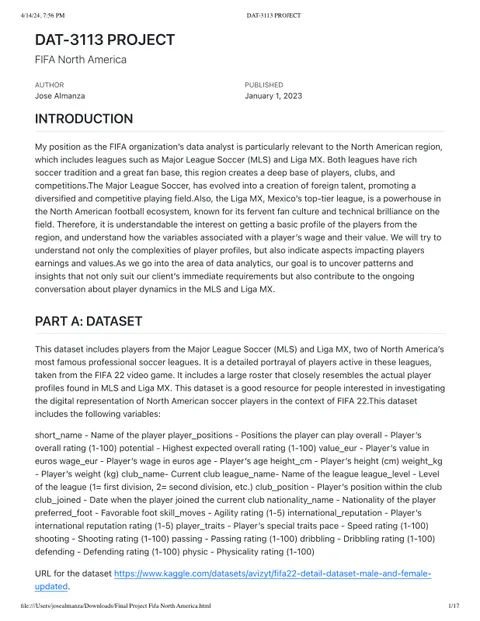
The problem
Taking the role of FIFA's data analyst for North American soccer, I examined player dynamics in Major League Soccer and Liga MX. Clubs and decision-makers need evidence for recruitment, contract negotiation, and squad planning. So what actually drives a player's wage and market value?
Dataset & context
FIFA player data filtered to the two leagues: 1,259 players and 26 variables, including positions, overall rating, potential, market value and wage (in euros), age, height, weight, club, league, and nationality.
Methodology
- Summarized key variables such as wage and value with means and medians.
- Visualized relationships with contingency tables and scatter plots.
- Grouped players into five clusters to surface distinct profiles.
- Fit a multiple regression of market value on overall rating, international reputation, wage, potential, and age.
Tools
- R
- ggplot2
- cluster
- knitr
Key analysis
| Predictor | Direction | Result |
|---|---|---|
| Overall rating | + | Significant |
| International reputation | + | Significant |
| Wage | + | Significant |
| Age | − | Significant |
| Potential | + | Not significant (p = 0.32) |
Findings
- Player incomes vary widely. A small group earns far more than everyone else.
- Wages and market values are strongly correlated: as wages rise, so does value.
- Higher-rated players were more likely to be starters and to earn larger salaries.
- Holding the other factors constant, older players carried lower estimated market values, and potential added nothing significant beyond current rating.
- Clustering surfaced distinct archetypes, from seasoned veterans to rising stars.
Business implication
Clubs and league decision-makers get a framework for strategy: which attributes justify a higher valuation, how to benchmark contracts, and how to plan a squad around distinct player profiles.
Final result
A 17-page analysis with five player profiles and a value model that explains 64% of the variation in market value.
What I learned: detailed analysis is what makes a player market understandable. Football economics is complex, and decisions there should rest on data that keeps being revisited.